I Do Declare: The U.S. Navy could use a dose of my dad’s humor on its 245th birthday

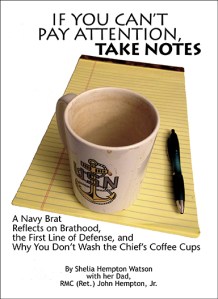
The following is an excerpt from a book I wrote with my dad. The full title (shown in the image to the left) is, “If You Can’t Pay Attention, Take Notes: A Navy Brat Reflects on Brathood, the First Line of Defense, and Why You Don’t Wash the Chief’s Coffee Cups.”

That title almost constitutes a whole chapter by itself. Dad would have approved.

Dad loved the Navy. He was a natural storyteller, and sea stories were his favorites. He retired as Chief Radioman in 1978, and he died in 2017. A lot of sea stories were told between those years.

Here’s one of them:

~ ~ ~

My dad always had a way with vehicles. A magic touch, you might say. And it wasn’t just a matter of making it run smoothly; his ability to acquire vehicles for little or nothing was an art.

Take that time he found a jeep in perfect running condition. Not bought, not borrowed: found. And then he got to keep it, courtesy of the U.S. Army. It might have been his best auto purchase, considering there was no purchase at all.

But I’ll let him tell the story his way:

I had been transferred from the main communications centers to the harbor entrance control post. That post controlled all the shipping and boats, including fishing boats, in and out of the harbor of Da Nang.

Transportation from our barracks to the post was “iffy” most of the time. The buses were usually broken down or if they worked, then they couldn’t find a driver. We ended up walking the three miles almost every day.

After I’d been there about three months, I found a jeep.

I was walking to work with Bill, a guy who worked in Operations. Same building where I worked, down the hall from my office. We stood watch together a lot, so we usually made the trip to the post together.

This one day, we were walking along, and as we rounded a corner, we saw an Army jeep on the side of the road.

We thought it was odd. Here’s this jeep out in the middle of nowhere, just sitting there. Bill and I walked around it and looked it over good just in case it was booby-trapped. We didn’t find anything, so we got in and hit the starter. What luck – it cranked right up!

We didn’t know why anyone had abandoned the jeep, but we were going to take advantage of the free ride.

Then we went about two feet and realized why it was just sitting there abandoned. The tie rod had come loose, and the front wheels were headed in different directions.

Good thing we had left the barracks early that morning – since it looked like the bus wasn’t going to make it again – because we had time to run back and get some bailing wire to tie up the rods. We did, and we fixed it up.

But then Bill and I got to thinking. The Army might be coming back for it, possibly with their motor pool – or worse, with armed guards – and it wouldn’t do for us to have it in our possession. So instead of driving off with it, we left it there.

When we got off work the next morning, we saw it was still there. Now most of us in the Navy didn’t have a terribly high opinion of the Army, but we knew that even they wouldn’t take twenty-four hours to fix a jeep. So we drove it back to the barracks. We figured they’d come looking for it and we’d let them know we fixed it.

They never did, though. We drove it back and forth for several days until it finally ran low on fuel.

We took it over to the Navy fuel depot. A supply clerk filled it up and noticed that it was an Army jeep, not one of ours.

I started to pay for it, but the fellow said he’d charge it to the Army.

“No, that’s all right,” I told him. “I’ll pay for it.”

“Nope. It’s the Army’s jeep. They’ll pay.”

What the heck, I let ’em pay. Who am I to argue with military protocol?

So we kept driving it. Then about a month later, Bill took it into town. He stopped in at the club, had a few drinks, and ended up staying out past curfew. The MPs arrested him, and he called me for help.

By this time, he was in deeper trouble than just staying out past curfew. He was a sailor driving an Army jeep with no papers, and no one believed his story about finding it on the side of the road and fixing it.

I caught a ride over there after my watch was over, and I explained everything to the provost marshal.

At first the provost marshal didn’t believe me either, especially when he found out I was a radioman. Not that a radioman can’t know how to work on cars, but this man just wasn’t buying the story.

I told him all about my background working on cars and all, and he finally took my word for it. But he was still fit to be tied.

Turns out the jeep had already been marked as transferred stateside and taken out of their inventory. It would create a lot of paperwork and probably start an investigation if they acknowledged that it was still in Vietnam.

He sat there, his face getting redder and redder, and he glared at both of us. Finally, he passed sentence.

“Just keep it!” he said. “But don’t tell anyone around here where you got it.”

We agreed. He closed the case. Then he had his motor pool fix the front end for us.

And we had free gas for the rest of our tour. All we had to do was pull up to the depot and tell them to charge it to the Army.

~ ~ ~

Want to read more? You can find it here.

Fanthology 10.7.2020

Check out these cool stories I came across this week:

Get social! At Freelance Writing Gigs, writer Kimberly Black shares info on the Benefits of Networking with Other Freelance Writers.

Speaking of social – be sure you do it right. Jeanne Veillette Bowerman at Script Magazine has some advice on social media etiquette.

For the DIY crowd, Derek Haines at Just Publishing Advice shows us all how to format an ebook in Microsoft Word.

Writer Katie Buller outlines self-care for authors – advice we would all do well to heed.

File this under “Love the Environment”: Good News Network shares a story by Andy Corbley about a super enzyme that eats plastic bottles.

Fanthology 9.30.2020

Check out these interesting and helpful tidbits I came across this week:

  • Matt Ott, one of my colleagues, penned this timely and thought-provoking piece on personal resilience.
  • Every writer has questions from time to time. Writer’s Digest has some publishing FAQs with answers.
  • Why have your characters walk into a room when they can amble, shuffle, stagger, and so on? One of the readers of Go Into The Story provides a PDF of 115 words for “walk” and a bonus PDF of 90 words for “look.”
  • If you’re planning to do National Novel Writing Month (held in November) this year, be sure to check out The Ultimate Guide to Planning for NaNoWriMo by writer Savannah Gilbo. This comprehensive guide is chock full of good info on novel-planning for any month.

I Do Declare: The bots are connecting some weird dots on my job searches

The artificial intelligence (AI) bots are mucking up my job search and, I suspect, trying to mess with my head. True story.

Like many these days, I have turned job searching into a primary activity, and the job posting sites have became acutely aware of this. Lists of companies looking for someone like me land in my inbox all the time. And I do mean All.The.Time.

That’s not the problem. The problem is that the specific jobs included in the listings are getting more and more … how shall we say? … outside of my wheelhouse. And by that, I mean sometimes the job post and I are not even on the same boat, nor indeed even on the same planet.

I’m a writer/editor. I work with words. The job market for me is not hard to understand. Content manager, copywriter, copyeditor, technical writer, proposal manager, reporter, grants writer: These are the types of job postings I expect when I open the email.

But not long ago, along with writer/editor jobs I started to get job postings like the following, which I am not making up:

  • Home Care Aide
  • Paint Shop Manufacturing Engineer
  • Border Patrol Agent
  • PT Night Trash Collector
  • Special Agent with the Federal Bureau of Investigation
  • Restaurant Biscuit Maker
  • Naval Aviator

Now, these are fine jobs. But trust me when I say there is nothing on my resume that would point to my being qualified for any of them.

Unless Monster, Indeed, Glassdoor, LinkedIn, et.al., were just throwing things out randomly to see what would stick, I figured there had to be a broken algorithm somewhere. I bent thought on how to fix it.

Earlier in my career I did a bit of programming and database work. One thing I learned is that when you’re troubleshooting a database because it has – and please forgive the jargon here – gone all wonky, it helps to start with a simple question:

What does the database think I’m asking it to do?

That often helped me track down the error and fix the code. I tried applying that logic here.

Q: What do these job sites think I’m looking for?

A: Uh…haha…no clue.

And then I gained some insights into this mystery when I came across the new docudrama “The Social Dilemma.” If you haven’t seen it yet, I highly recommend. It’s up on Netflix, which gives this description: “This documentary-drama hybrid explores the dangerous human impact of social networking, with tech experts sounding the alarm on their own creations.”

I found it both eye-opening and chilling. But I also think it explained a lot, especially when I learned just how much the AI bots were tracking my online movements and storing them as data.

Sure, I had an inkling this was going on, what with having a conversation – in the presence of my smart phone or smart TV – that I was thinking about going to Home Depot and then :::BOOM::: a Home Depot ad pops into my Facebook feed within minutes.

That can be a bit unnerving, depending on the details of the conversation and how much of a smarty-pants the smart devices are, but overall, I get it. The closer you target, the more likely you can close a deal, which means you need to gather data so you can zero in and hit the target. Sure, fine.

Except that these AI bots – at least according to this film – are measuring everything: the people I’m friends with, the lists I follow, the videos I watch, how long I stay on a certain site before scrolling to something else, my Google searches. And then they use these bits of data to come to conclusions about me, which might be wildly off-base.

Take the time I spend on a site, for instance. That’s easily explained. If I pause for an unusual amount of time it’s probably because I stumbled across a bizarre political story and I’m shaking my head in disbelief, whispering “What The What…?”

My Google searches, though. This might be where it starts to go off-rail, because connecting those dots would draw a totally different picture.

You see, I write historical novels. These often require some digging, hence the occasional online searches that can be … well, let’s just call them a bit odd.

For example, when I was writing my book “Turning August,” which is set in Germany during World War II, I needed to find out a wide range of details, such as the euthanasia program, how fast one could travel from Munich to Berlin in a 1940s vehicle, images of members of the Resistance movement, and which French cities were bombed first.

For the cover photo shoot, I ordered a vintage 1940s needle/syringe and an authentic Wehrmarcht uniform on eBay. (I worried what my credit card company thought of me and wanted to send them a note of explanation: “Don’t judge me! These are just photo props!”)

My current work-in-progress is set in the Renaissance period. Thanks to Google, I can tell you where Cordoba is located, when Isabella and Ferdinand took over Alhambra, what happened when Columbus sent his brother to talk to Henry VII about funding his trip to the new world, how long it takes to sail from Marseille to the Port of Palos, exactly how fast a peregrine falcon can fly, and the French word for balcony.

Given my overactive online researching, I really shouldn’t wonder that the AI bots are confused about my capabilities and interests. Though I am curious to see what pops up next. Sword-carving apprentice? Lady-in-waiting? Falcon trainer?

After being invited to apply for Border Patrol, FBI Special Agent, and Naval Aviator, I’m up for anything.

Even making biscuits.

~ ~ ~

Update: Moments after I posted this, another email dropped in with new jobs, including this one:

  • Firearms Instructor for the Department of Homeland Security

Seriously, bots, you’re starting to worry me.

Fanthology 9.23.2020

A few interesting and helpful things I found this week:

  • Running short of ideas? Check out this list of 300 story ideas from Go Into the Story. The blog is written by Scott Myers, who is the most generous man on the planet.