I Do Declare: Humor is a funny way to stay fit

When a new acquaintance finds out I’m a writer, I will invariably get The Question: “So what do you write?”

Which is a little bit like asking someone: “So what do you eat?”

Because the answer is pretty much the same: “Everything I want to.”

No, I’m serious (about writing and eating).

My portfolio runs the gamut from nonfiction books and historical fiction novels to news articles and features to business and personal profiles to human interest and tourism stories to white papers and technical documentation to grants and proposals to humor in various media.

And it’s the last item – humor – that got me through (and continues to get me through) the toughest of all other assignments and projects.

My long-term projects (novels) have the occasional light moment, but for the most part, they’re drama fiction. Take, for instance, my historical novel, Turning August, which is set in Germany in World War II and deals with the Resistance. Yeah, a pretty deep subject. Lots of drama.

I wrote a scene (after a huge amount of research) about the Babi Yar Massacre (if you want more info on it, click here … take a deep breath and say a prayer before following the link), and afterward I flopped onto the sofa and sobbed for a long time. The tears would not stop; it was that intense. I called a friend, and she talked me back up into the daylight.

After I calmed down, I remember saying, “Wouldn’t it be weird if I end up in therapy because of a novel I’m writing?”

She thought for a moment and said, “That’s why the light is so important. What you’re writing is important and you need to do it, but you also need to find the light. Find something lighthearted to watch or read – or better yet, something to write.”

Excellent advice from my friend. And she was right – it does help to turn to something lighthearted after such a deep focus on intense drama. Laughter (or humor in general) is healing. Besides being a mood-lifter, it can improve the immune system, sleep quality, and memory, plus a host of other benefits. (Dig deeper into the topic with a few authoritative bits of info here and here and here.)

For me, humor is also a productivity booster. When I take a few moments to create humor pieces, I find that my mood is consistently better, my work on long-term projects is of a higher quality, and I’m eager to get to work every day.

Hence the part of my blog called “Good Cheer,” which includes Belle of the Ballyhoo (a comic strip about a freelancer dealing with all the craziness of contract work) and Vim & Verve (conversations between two alligators who critique movies and TV shows with a lot of snark).

I also highlight a range of memes featuring Reggaetor (an alligator who listens to Bob Marley), Grammarcat (a feline who silently judges your grammar), Writer Girl (a fashion doll always trying to meet her deadlines), Haiku To You Too (silly haikus with amazing photos), and Wine Me Up (exactly what it sounds like).

The Book of Proverbs – ever the astute guide – notes that “A cheerful heart is good medicine, but a downcast spirit dries up the bones.” (Proverbs 17:22, NRSV)

I like the “good medicine” of writing humor. It’s a pleasant taste. And it keeps my writing muscles fit.

I Do Declare: When it comes to productivity, rest is best

Today is Labor Day in the United States, one of the 11 federal holidays (12 when the year has an Inaugural Day), which for most people means: Don’t you dare do anything resembling work, unless it’s laboring over a grill in your backyard.

Labor Day was established as a federal holiday in 1894 by President Grover Cleveland in recognition of workers’ rights. Which I’m sure was a great idea at the time. However, it has since evolved into a recognition of the right not to work that day.

In the interest of accuracy, I’m thinking it really should be renamed Rest Day.

Which isn’t a bad idea. (Resting, I mean, not renaming the day.) Especially for all you creatives out there.

Let’s be honest. If you’re a contractor / freelancer, chances are you tend to have a mindset something like this:

I want to achieve … so I need to stay productive … which means I need to keep working … so I can be in constant motion … to achieve all I want to get done.

You know what the problem is with that mindset?

We’re not Energizer bunnies; we can’t keep going and going and going, even if we do have a cute little drum to beat on as we go merrily along.

Besides, perpetual motion doesn’t work with humans. That whole concept is hypothetical anyway, because a machine that can work indefinitely without an external energy source would violate the first and second law of thermodynamics. And I know that only because I have befriended Google.

Think about it: Even God rested from His labors on the seventh day. Trust me, you’re not going to one-up God. Don’t even try.

So let’s get real, creatives. If you want to keep going, you need to rest now and then – or better yet, on a regular basis.

Take a break before you break is what I’m saying.

Here are a few ideas for embracing the noble concept of rest:

Physical Rest

  • Get proper sleep, by which I mean: Turn the TV off and go to bed on time.
  • Fashion your bedroom into a total comfy zone. You can do this without expensive redecorating. Yes you can. Spray lavender (known for its relaxation properties) on the mattress and pillows when you change the sheets. I spray my pillows every day. The smell of it (let’s call it by its name: aromatherapy) helps me get into a deep sleep.
  • Do whatever you can to work in nap time during the day. Kindergarten teachers know what they’re doing: Naps are good for you. Plus, if your high energy is first thing in the morning, if you take a nap midday, you get two mornings out of one day. Win!

Mental/Sensory Rest

  • Unplug from sensory overload. Leave the TV off for a day (or several days). Ignore the news for a while (trust me, it’ll be there when you get back).
  • Write in a journal to get any negative thoughts out of your head. Or start a gratitude journal so you’re focusing on good things. Or both.
  • Try some relaxation exercises, like deep breathing, yoga, qi gong, or t’ai chi.
  • Take up a hobby that uses other parts of your brain (thereby giving the parts you’re pushing hard all the time a break), like jigsaw puzzles, painting, knitting, or needlework.

Emotional/Social Rest

  • Put deliberate boundaries around social media – i.e., no screen time at least an hour before bed and no peeking at Facebook if you wake up during the night.
  • Know your introvert or extrovert leanings – are you energized by being in a crowd or by pondering alone? – and adjust your expectations accordingly.
  • Be authentic in your relational contacts: Don’t be afraid to say no (it can be done gracefully), let your friends know if you’re in need, and put a moratorium on unhealthy relationships.

Creative/Spiritual Rest

  • As much as possible, set boundaries around work. (It’s ok to not be available 24/7.)
  • Connect with your spiritual nature – e.g., read an inspiring Bible passage every morning and meditate on it, join a church group, listen to inspiring music that reminds you that you are a child of God.
  • Fill your soul with nature. Take a walk through a park. Hike through mountain trails. Walk on the beach.

The benefits of rest are so much worth any cost of taking up any of these suggestions: a better immune system, improved mental health, and an increase in creativity. Worth a try, isn’t it?

I Do Declare: The clock is a fierce opponent

I get up every morning, don my battle gear, and go to war … with the clock.

The battles I fight, the struggles I face, and the campaigns I map out are all about choosing the best time of day to get things done.

My high energy time is in the morning. That being the case, logic would dictate that I should be doing the most creative things at that time.

But some days logic takes a sharp right turn, and the to-do list elbows its way to the forefront. I tell myself I’ll just get these couple of things out of the way so I can focus the rest of the day on my passion projects.

You know how that ends.

The tasks take up a chunk of time – or worse, they deplete what energy I had, and I’m left running on empty when I do get to the passion projects.

The thing is, those times when I do start the day with one of my passion projects, I don’t want to stop. I get in the middle of it, become mesmerized and focused and just want to be there all day.

That’s no surprise: It’s my passion, it’s a creative endeavor, it feeds me and it gives me more energy. Who doesn’t want to dwell in that place?

And yet, there’s something in the back of my mind that worries that if I get too involved with a creative project right away, it’ll be hard to get to the tasks I have to get done (the routine, the gig assignments, the do-it-or-else tasks, you know what I’m talking about) – or worse, I’ll neglect them or be late completing them, then I’ll have to scramble to catch up.

It’s not just a what-comes-first issue. I battle with squeezing in creative work on the checklist, in between other must-do work. My experience has been that piecemealing creativity is not optimal.

And yet, what if piecemeal is the only way I’ll get everything done?

This war I wage over the clock is ongoing, and moments when I can “stand down” are rare.

Are there any creativity warriors out there who can share their battle stories? I’d like to hear about some campaigns that were won or weaponry that helped turn the tide.

I Do Declare: A good opening line is like a siren call to the muse

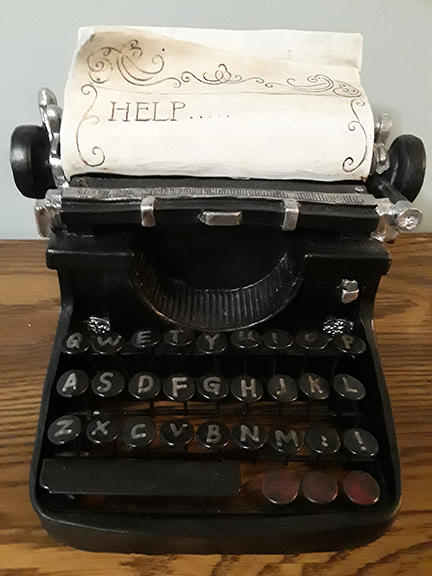
typewriterSometimes it’s hard to get started. This I know all too well, having spent many a day staring at the computer screen, hands poised, waiting for inspiration to take over.

But let’s be honest. No self-respecting muse will dash to your side and start nudging and cajoling you into doing your own work. You have to get going first. Then she shows up.

This being the case, I am always on the search for ways to kick-start my writing. One effective way I discovered is to take an opening line and free-write for about 15 minutes. That quarter of a hour usually gives me enough forward motion to get into the story I need to be doing.

The cool thing is sometimes those warm-up exercises turn into stories themselves.

Try it out. Here are some opening lines to help propel you into your story:

  • The cure for seven deadly diseases sat on the shelf in the room across the hall, and no one could do a damn thing about it.
  • I’ve never quite gotten over my fascination with Milton.
  • There are three perfect ways to die, and by the time she was 23, Sally had learned them all.
  •  I never should have given him the code.
  • Henry happened to be there when the tide pulled a jon-boat past the dock, its hull empty except for a cast net in the bottom, full of shrimp.
  • At some point, all parents have to lie.
  • In the woods behind the house, Mary and Janet found a magic hat.
  • Lord have mercy, the sermon lasted so long I forgot I was still mad at the preacher and shook his hand on the way out without meaning to.
  • Voicing an unpopular opinion on Twitter is to face judge, jury, and executioner all at once.
  • No one could have predicted that three hours one afternoon would change the world.

If none of these are to your liking, you might try opening up a magazine or newspaper, grab the first sentence you see, and use that as your opening line.

Go write right now!