What can you accomplish in 10 minutes? More than you think!

If you find yourself crunched for time amid your work-in-progress, I highly recommend 10 Minute Novelists.

The header on the site says, “Recognized by Writer’s Digest List of 101 Top Websites in 2016, 2018 & 2019,” and there’s good reason why. The site includes informative blog posts, writing challenges, and perhaps most important, a community of like-minded people – i.e., time-crunched writers.

It was started by Katharine Grubb back in 2006, and … well, she tells the story best here.

The community “gathers” in a Facebook group (check it out here). I joined many years ago, and it’s still one of my favorite groups. Like many Facebook groups, there are strict rules (e.g., no self-promotions, membership restricted to individuals, professional courtesy maintained, etc.), which keeps the group – now up to 15,000+ members – running smoothly.

The Facebook group includes a Question of the Day, Monday Blogs (where you can share the latest post of your blog if you have one), Buddy Day Tuesdays (where you can find help, such as beta readers), and Author Happiness Wednesday (where you can share whatever good is happening in your world).

The posts from members, usually regarding a particular problem the writer is having with a work-in-progress, are often valuable lessons and sometimes entertaining.

Mike and his spaghetti models keep us all even-keeled

Huge shout-out to www.spaghettimodels.com (on Facebook as Mike’s Weather Page and on Twitter as @tropicalupdate). I recommend following him everywhere you find him.

It’s not necessarily something to help with your writing, but it’s definitely a sanity saver if you live on the coast and see a hurricane heading your way. As was the case this week with Hurricane Isaias.

Mike’s web site is a treasure trove of graphs, charts, and models curated from weather sources. Seriously – this screen grab (below) is showing only a tiny piece of all the site offers.

Mike typically gives live updates on Facebook to explain the different models and charts – and he does it with a dash of humor, which, let’s face it, one can use when the weather gets crazy. He often features his two sidekicks (French bulldogs), Hurricane Louis and Hunter.

spaghettimodels
http://www.spaghettimodels.com


Remote and flex jobs

If you’re in the market for remote/virtual or flexible job, two of the best job posting sites out there are Virtual Vocations and FlexJobs.

The job postings include part-time, full-time, remote, and contract.

You can access both to browse jobs, but you have to be a paid member to access the full postings.

I’ve used both and have gotten decent gigs through them. Highly recommend.

Winning your way onto the screen

Here’s one for my fellow screenwriters out there. MovieBytes is my go-to for all the info on upcoming screenwriting contests, including:

  • Full details (objective, rankings, deadlines/entry fees, discounts if available, awards, etc.)
  • Contest directory (sorted a host of ways, such as: most significant, regional, festival, free, etc.)
  • Contest calendar (final deadlines only)
  • Deadline alert on the righthand column
  • Contest news
  • Info on winning scripts (writers can add to the database where producers/agents/managers can access them)
  • HollywoodIQ (news and interviews from the industry)
  • Free newsletter delivered to your inbox

Circling the © sign: resources on copyright law

If you’re going to write and get published – whether blog posts, newspaper/magazine articles, books, whatever – sooner or later you’re going to encounter these (and other) issues with copyright:

  • Knowing how and when to file a copyright on your work.
  • Making sure you’re not violating copyright or fair use laws when you’re quoting or linking to someone else’s work or site.
  • Knowing what to do if someone violates the copyright on your work.

The U.S. Copyright Office has more information than you ever thought you’d need on copyright laws and policies, including details on Title 17 of the U.S. Code and Fair Use.

Find them on Twitter (@CopyrightOffice) or on YouTube (/uscopyrightoffice).

They also have a blog and offer several email subscriptions.

Another excellent resource is Copyright Law in 2020 Explained in One Page, which is much more readable than the .gov info.

LOC is a researcher’s BFF

Doing some research on your work-in-progress? Check out the Library of Congress Research and Reference Services. You’ll want to bookmark it so you can spend quality time there.

I found it to be one of the most pleasant rabbit holes I’d ever gone down.

If you’re not familiar, I recommend starting at the Quick Links (on the far right column) with the Getting Started and Frequently Asked Questions pages.

Also bookmark-worthy:

Conquering the to-do list

How I get things done would make an interesting study … mainly in how to be a control freak.

I live by to-do lists. A clock sits next to my computer screen so I know what time it is every second. I have a calendar habit that few understand: wall calendars, day planner inserts, daily Sudoku, word of the day, 3-month, huge write-on … you name it, I have it, including some I produce in Word because I haven’t found that particular style yet.

All of this is so I can better manage my time so I can be more productive. Yes, there are benefits to slowing down, smelling the roses (or your flower of choice … actually, mine is the hyacinth), meditating, long walks in the park, whatever. I concede that point.

But for me, what works is dividing my time, listing what I need to do, and pushing myself to that accomplish it. And when I do … bring on the rewards!
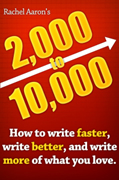
2kto10kbookI’m always on the hunt for better time management tools, and I found one in a book by Rachel Aaron called “2,000 to 10,000: How to write faster, writer better, and write more of what you love.” Check out her blog post (and link to purchase her book) on the subject.

The basic premise is the triangle of writing metrics: Knowledge (know what you’re writing before you write it), Time (track productivity and evaluate), and Enthusiasm (get excited about what you’re writing).

I love the way she breaks down this concept, especially the need to track productivity and evaluate it. I’ve always called myself an early riser, more productive in the mornings. But am I sure about that? I haven’t taken the time to track when and how much I’m writing, so it’s possible that I get more done in the afternoon or evening. I’ll be doing that over the next few weeks.

Getting excited about what I’m writing is something else I need to ponder. She describes on her blog and in her book how she spent days stuck in one scene. (I know the feeling.) She said she realized that it was because the scene wasn’t interesting enough to her. The solution? Make it more interesting … or cut it. Think about it: If you’re not really into the scene, will the reader be?

The Knowledge leg of the triangle I think I already have a handle on. A huge part of my writing life is organizing and outlining, so I’m almost always aware of where the story’s going today.

I definitely think this method will work with novel writing, but I’m also revising it slightly for screenplays. With screenplays, word count isn’t what I’m after – it’s pages completed. So here’s the plan: a typical screenplay has roughly 100 pages. If I write five pages per day, I can finish a rough draft in 20 days. Time spent revising, editing, and polishing is another matter. But getting the rough draft done – or as a wise man once said, “Get the damn thing done!” – will be an accomplishment worthy of reward.