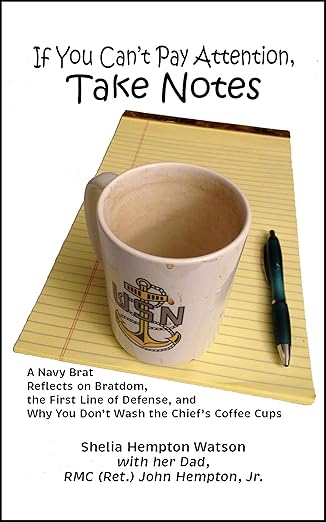
I found one of my best characters by paying attention and taking notes

One of my readers once asked how I come up with the complex characters for my novels and give them their particular mannerisms. The answer is complex: a mixture of research, a study of traits and personalities, close observation of people, watching their habits and quirks.

Many articles and books and creative writing courses have been written about character development, and my initial thought was to refer to those sources.

But as I thought about the question, I realized I had a good short answer: I listened to my dad talk. Thoughout his life, Dad invariably found himself connecting with the most curious and remarkable characters and, being the fabulous storyteller that he was, he loved telling the stories of these people.

In a book I wrote with him – “If You Can’t Pay Attention, Take Notes,” a collection of his sea stories – one of the vignettes highlights Dad’s friendship with an undercover NIS agent, completely unaware of the agent’s identity.

I was so intrigued by this character that I put him in a series of novels I wrote (the “Para Team 1” series) that involve an agent with a special unit of Naval Intelligence.

Here’s Dad’s account of the inspiration for my character, as told in his sea stories (more info about the book here):


When I was stationed in Norfolk, I met a fellow who worked in the Beachmaster unit with me. Mike was a second class boatswain’s mate and had been for a long time. You could tell by the stripes up his arm that he’d been taking the first class test for a while and obviously hadn’t passed it yet. The boatswain’s mate first class test was hard to pass.

That didn’t seem to bother him, though. He was a nice, easy-going guy – loved to tell jokes and play cards and fish. We had a lot in common.

Mike was married and had two kids. We went fishing all the time, and he and his wife came over and played cards with me and Pat. Over the course of a year, we got to know them pretty well. We even went on vacation together.

One day two military police came to the door of our building. Mike was standing between them. The MPs asked to come in to talk to a particular chief who was on duty. I told them it was a secure building and I couldn’t let them in, but if they would wait there, I’d go get him.

I found the chief and took him to the door, and the MPs arrested him. The whole time Mike didn’t look at me. I was worried about what kind of trouble he was in.

I found out from some others in the building that the chief they arrested was suspected of selling answers to the first class test. Now I was really worried about Mike.

As soon as I got off duty, I went to his house to see his wife and let her know I was going to the brig to see Mike. But when I got there, the house was completely empty. All of it was gone – the furniture, their clothes, the food in the refrigerator. Nothing was left. No moving boxes, nothing in sight.

By this time I was thoroughly confused, but I made my way over to the brig and asked if I could see Mike.

He wasn’t there. In fact, they had no idea who I was talking about.

When I got home, I told Pat about it. She was shocked. She had just seen Mike’s wife in the commissary the day before.

When I got to work the next day, I found out that Mike had been working undercover with Naval Intelligence. They had known for a while that someone was selling secrets to the test, but they weren’t sure who it was. Mike – obviously not his real name – had been working on the case all that time.

Several years later I was stationed in Charleston. One day I was walking across the base, when I passed someone who looked familiar. I turned around; he turned around. We stared at each other for a moment.

It was Mike.

But he was no longer a second class boatswain’s mate. Now he was a chief engineman.

He looked surprised, like he didn’t know what to say, but then he extended his hand.

“John, how’s it going?” he asked.

“It’s going good,” I said. I wasn’t sure what to call him, so I hesitated. “What are you doing here?”

“I’m stationed on the Sierra,” he said.

I didn’t ask him why. I figured he probably couldn’t tell me, and whatever he did tell me wouldn’t be true.

So we talked about fishing. After about ten minutes, he went on his way and I went on mine.

About a week later, I heard about a drug bust on the U.S.S. Sierra. I wasn’t surprised at all.

I never did see Mike again. At least I don’t think I did. Might depend on whether he got good at disguises.

I Do Declare: It feels pretty good to complete a book

As I mentioned in a previous post, I took a hiatus for a while, during which time I wrote a book (among many other endeavors, some pretty awesome, some not so much).

Which means, sadly, that I missed the moment to do a blog launch for my book.

Well, here it is: Charleston Celebration: A History of Pleasurable Pastimes from Colonial Charles Town Through the Charleston Renaissance (published by Globe Pequot Press, an imprint of Rowman and Littlefield). It’s available everywhere; just ask your local bookstore to order it. (The link above goes to Amazon.)

In upcoming posts, I’ll favor you with an excerpt or two as well as some insights on how and why I wrote it — but for today, here’s the intro so you can get a feel for what it’s about:

* * *

Introduction

Many books have been written about Charleston, a fact that should surprise no one. The Grand Dame of the South has been here for centuries and has many fascinating tales to tell.

The tales are so fascinating that, I do declare, doing the research for this book was the best rabbit hole I’ve ever been down.

There are books and articles that detail how Charleston endured the Revolutionary War and the Civil War, write-ups that dig into specific topics like architecture or piracy, and published pieces that offer insights into the people, places, and politics.

One doesn’t have to search long to find a wealth of information about Charleston: short histories, in-depth studies, surveys, compilations, the lighter side, the darker side, and a treatise on just about every aspect of the city.

This book delves into one specific aspect: Charleston’s pleasurable pastimes through the years. And there are many. There’s a reason Charleston keeps receiving accolades like being voted year after year as Best City to Visit, Friendliest City, Most Enjoyable Place to Visit, and so on.

The simple truth is that Charleston loves to entertain and to be entertained. She seeks out the beauty and joy and pleasure in her charming surroundings, and she invites others to enjoy them as well.

In her book, Prints and Impressions of Charleston, celebrated artist Elizabeth O’Neill Verner wrote that, “It is so difficult for a Charlestonian to write about Charleston without becoming either sentimental or austere.”

How right she was. At one point in my research, I realized that I could either wax eloquent on every instance of entertainment – and, because the city never stops seeking enjoyment, possibly never finish the book – or accept that it might not be possible to capture and catalogue every instance of amusement throughout the years. I went with the latter, and I hope you, gentle reader, will forgive any omissions.

This book was a great pleasure for me to research and to write. It is my fervent wish that you will find great pleasure in these pages.

Shelia Watson
West of the Ashley
Charleston, South Carolina

I Do Declare: A WW2 spy thriller is the best way to get past the turkey leftovers

Need a break from political discourse and turkey leftovers?

Well, who doesn’t?

I’ve got you covered right here with an excerpt from my WW2 spy thriller, Turning August.

Before you jump into the chapter, it might help to dig into some background from the back of the book:

===

August Wichmann had been warned.

As a young professor of linguistics at Munich University, he captivated his students with role-playing in the personas and culture of the different languages he was teaching.

It was the perfect skill set for the SS, who recruited him to gather intel on seditious acts.

But he had been warned.

His sister argued against his enlistment. Friends and colleagues encouraged him to reconsider. Brigitte, a vivacious medical student, made a compelling case against working with the regime.

But August was idealistic and dedicated in service to his country. He took on the role of rising SS officer.

Then he witnessed firsthand the atrocities committed by the Nazis.

His attempts to stop the evil were compromised by threats to those he loved. The Resistance discovered August and wanted to use his skills to ferret out information that could turn the tables on Hitler’s henchmen.

While pretending to be loyal to the SS, he had to feign indifference to the brutality so he could gather intel on Nazi activities and keep his cover safe.

Desperate in this no-win state, the only one who truly understood August’s torment was Brigitte, herself an unwitting pawn in the Nazi schemes. They both faced the haunting question that ever after steered their course:

After you discover the truth, how do you atone for believing the lie?

Set against a tangled web of Abwehr agents and double agents, broken trust and deception, and the earnest hopes and thwarted plans of the Resistance, the story treads a precarious path of conscience in the face of evil.

Many of the characters are based on real people, including seasoned spymaster Admiral Canaris and theologian Dietrich Bonhoeffer – both presenting a fixed star by which August and Brigitte navigate the shifting moral boundaries required to fight the Nazis from within.

===

That should tell you a little bit about the overall story. In this chapter, August has just returned from the Wannsee Conference, where the Nazis discussed the “final solution” of the Jews (including their plans for mass murder via gas chambers). August was required to attend because he worked for Heydrich – even though he despised the man and everything he stood for. If he refused, he and his family would be killed. At this point, he realizes how evil the SS is, but he can’t find a way out.

This chapter is the point when he is approached to work with the Resistance by none other than Admiral Canaris, head of the Abwehr. (He too was pretending to be part of a system he despised.)

===

Chapter 43

The car dropped August off, and he trudged up the steps. His shoulders sagged. Every breath, every movement was an effort. He felt stunned beyond coherent thought. The conference had done that to him. He wasn’t sure how he’d be able to exorcise it from his thoughts.

He went inside and locked the door. First things first. A drink.

He stopped, looked around, listened. He wasn’t alone. He pulled out his weapon and stalked his way into the living room.

Canaris was sitting on the sofa. “We have some things to discuss, so I dropped by. How was Wannsee?”

“The butcher told you? Damn it!”

“Of course he told me. He’s my asset.”

August eyed Canaris, leaning back on the sofa, a glass of scotch in his hand. There was no threat. August put away his weapon, took off his coat, and sat across from Canaris. His movements were slow and thoughtful. By the time he sat he was focused, calm, and collected.

“So you know I went to Wannsee,” he said. “What else do you know? Or want to know?”

“What else do I know? Let’s see…” Canaris took a drink and looked up. “I know your apartment isn’t bugged. We swept it this morning. So we’re free to talk.” He looked back at August. “I know you’re intelligent. And capable. We could use that.”

“We? You mean the Abwehr?”

“I mean the Resistance. A group of us who are committed to restoring honor to Germany.” He studied August. “You’ve already encountered it.”

August leaned forward and studied him. “The men at the SOE house. And the testimony from Dina and Hofer.”

“Yes.”

“This is a lot to reveal. How do you know you can trust me?”

“I don’t know that I can yet. I’m gambling on your sense of moral outrage at what you’ve discovered.” Canaris took another drink before continuing. “And I’m paying you the compliment of not trying to deceive you.”

“How do I know I can trust you?”

“Because you have no choice. Anything you tell Heydrich I can easily prove you withheld from him. And if I have to, I’ll lie about our role in it.”

Canaris watched August take that in.

“But that’s not why you’ll end up working with us,” Canaris said in a cool, matter-of-fact tone. “You will because you want to be part of this. You want to see Germany restored.” Canaris gave a slight grin. “Actually, you’re already working with us.”

“What do you mean?”

“You’ve kept it all secret.”

“Including that I have a secret.”

“Exactly.”

“You seem to know quite a bit already. What do you not know?”

“What was discussed at Wannsee.”

August looked away. “You don’t want to know.”

“Where can I get the documents?”

“Eichmann has the only copy.”

“We’ll have the butcher get a copy.”

August started to tell him that it would be impossible to get  a copy. But then he realized how many others things Canaris was aware of. Plus the fact that he had found his apartment and gotten in. What was it Canaris had said to him on the train? There isn’t much we don’t know. August thought there wasn’t much that was impossible to this man.

Canaris stood. “Let’s go.”

“Where?”

“To find out about your sister.”

They walked to a car parked down the road. Oster was waiting behind the wheel. August and Canaris got in the back.

August turned to Canaris. Time to set terms.

“Admiral, if I’m going to do this, I want to be sure we can trust each other,” August said.

“I value what you can do, August. But trust costs more.”

“You value what I can do?” August gave a short laugh. “Says one professional liar to another.”

Canaris looked out the window to hide his smile. How many were bold enough to counter his statements? It was refreshing. Yes, he liked this August Wichmann very much. He hid his smile and turned back to look August in the eye.

“I will never deceive you. You have my word,” he said, his voice quiet and firm. “I expect the same courtesy from you.”

August regarded him for a moment and nodded. Terms accepted.

===

Ready for the whole story? It’s available from any bookstore. Or you can pop on to Amazon and grab the ebook and start reading today.


I Do Declare: The U.S. Navy could use a dose of my dad’s humor on its 245th birthday

The following is an excerpt from a book I wrote with my dad. The full title (shown in the image to the left) is, “If You Can’t Pay Attention, Take Notes: A Navy Brat Reflects on Brathood, the First Line of Defense, and Why You Don’t Wash the Chief’s Coffee Cups.”

That title almost constitutes a whole chapter by itself. Dad would have approved.

Dad loved the Navy. He was a natural storyteller, and sea stories were his favorites. He retired as Chief Radioman in 1978, and he died in 2017. A lot of sea stories were told between those years.

Here’s one of them:

~ ~ ~

My dad always had a way with vehicles. A magic touch, you might say. And it wasn’t just a matter of making it run smoothly; his ability to acquire vehicles for little or nothing was an art.

Take that time he found a jeep in perfect running condition. Not bought, not borrowed: found. And then he got to keep it, courtesy of the U.S. Army. It might have been his best auto purchase, considering there was no purchase at all.

But I’ll let him tell the story his way:

I had been transferred from the main communications centers to the harbor entrance control post. That post controlled all the shipping and boats, including fishing boats, in and out of the harbor of Da Nang.

Transportation from our barracks to the post was “iffy” most of the time. The buses were usually broken down or if they worked, then they couldn’t find a driver. We ended up walking the three miles almost every day.

After I’d been there about three months, I found a jeep.

I was walking to work with Bill, a guy who worked in Operations. Same building where I worked, down the hall from my office. We stood watch together a lot, so we usually made the trip to the post together.

This one day, we were walking along, and as we rounded a corner, we saw an Army jeep on the side of the road.

We thought it was odd. Here’s this jeep out in the middle of nowhere, just sitting there. Bill and I walked around it and looked it over good just in case it was booby-trapped. We didn’t find anything, so we got in and hit the starter. What luck – it cranked right up!

We didn’t know why anyone had abandoned the jeep, but we were going to take advantage of the free ride.

Then we went about two feet and realized why it was just sitting there abandoned. The tie rod had come loose, and the front wheels were headed in different directions.

Good thing we had left the barracks early that morning – since it looked like the bus wasn’t going to make it again – because we had time to run back and get some bailing wire to tie up the rods. We did, and we fixed it up.

But then Bill and I got to thinking. The Army might be coming back for it, possibly with their motor pool – or worse, with armed guards – and it wouldn’t do for us to have it in our possession. So instead of driving off with it, we left it there.

When we got off work the next morning, we saw it was still there. Now most of us in the Navy didn’t have a terribly high opinion of the Army, but we knew that even they wouldn’t take twenty-four hours to fix a jeep. So we drove it back to the barracks. We figured they’d come looking for it and we’d let them know we fixed it.

They never did, though. We drove it back and forth for several days until it finally ran low on fuel.

We took it over to the Navy fuel depot. A supply clerk filled it up and noticed that it was an Army jeep, not one of ours.

I started to pay for it, but the fellow said he’d charge it to the Army.

“No, that’s all right,” I told him. “I’ll pay for it.”

“Nope. It’s the Army’s jeep. They’ll pay.”

What the heck, I let ’em pay. Who am I to argue with military protocol?

So we kept driving it. Then about a month later, Bill took it into town. He stopped in at the club, had a few drinks, and ended up staying out past curfew. The MPs arrested him, and he called me for help.

By this time, he was in deeper trouble than just staying out past curfew. He was a sailor driving an Army jeep with no papers, and no one believed his story about finding it on the side of the road and fixing it.

I caught a ride over there after my watch was over, and I explained everything to the provost marshal.

At first the provost marshal didn’t believe me either, especially when he found out I was a radioman. Not that a radioman can’t know how to work on cars, but this man just wasn’t buying the story.

I told him all about my background working on cars and all, and he finally took my word for it. But he was still fit to be tied.

Turns out the jeep had already been marked as transferred stateside and taken out of their inventory. It would create a lot of paperwork and probably start an investigation if they acknowledged that it was still in Vietnam.

He sat there, his face getting redder and redder, and he glared at both of us. Finally, he passed sentence.

“Just keep it!” he said. “But don’t tell anyone around here where you got it.”

We agreed. He closed the case. Then he had his motor pool fix the front end for us.

And we had free gas for the rest of our tour. All we had to do was pull up to the depot and tell them to charge it to the Army.

~ ~ ~

Want to read more? You can find it here.