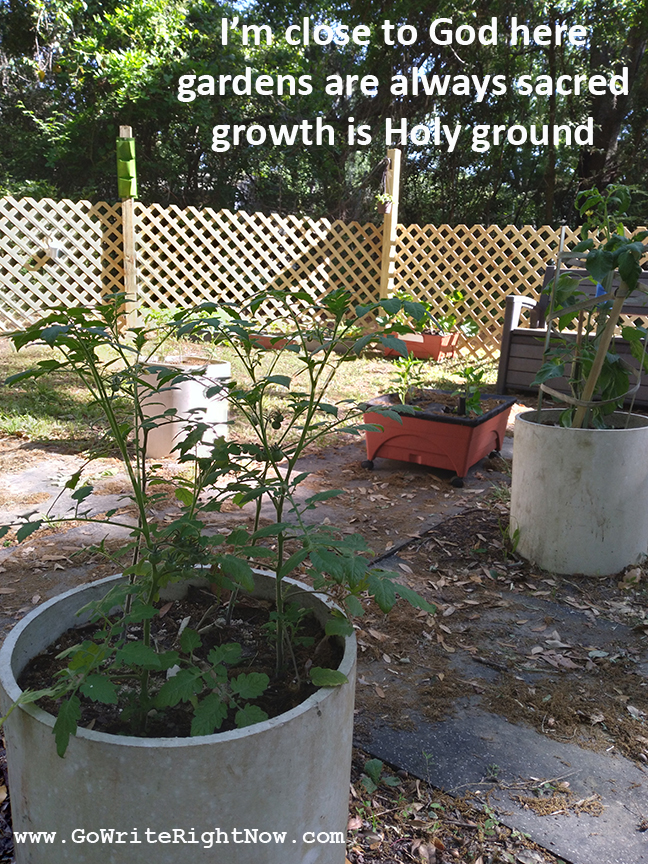
Not too crazy about gardening, but I do love gardens

I was going to post a photo of our raised bed garden — correction: our attempt at cultivating a raised bed garden — but the photo has a sad “before” look. By which I mean: We have a lot to do to prep it for next year’s crops. And none of that would be particularly nourishing or inspiring for any of you.

Instead, here’s a photo — with accompanying haiku (because of course) — from when we first started the garden. Enjoy!

p.s. I’ll post lots of photos of our garden after I have some “in progress” ones to go with our “before” photo.

A good critique can carry you for miles

I volunteered to write two devotions for the upcoming Advent booklet for my church.

Here are a few words I received back from the person who’s reviewing them.

I actually didn’t expect a review at all. I thought I’d turn it in, and that would be it. So getting a wonderful critique like this was extra special.

Your conversational tone draws readers right into Paul’s message — not only to understand it, but to feel it. Your reflection on the repetition in Philippians 4 is both fresh and pastoral. The encouragement to take “anything and everything” to God in prayer perfectly captures the heart of this passage — a reminder that joy and peace flow not from our control but from His nearness. The modern illustrations (like the “balcony” image) and the gentle humor make it wonderfully relatable while staying fully faithful to Scripture. It’s exactly the kind of writing that helps people connect deep theology with daily discipleship.

I received this critique on one of those mornings — filled with challenges and irritants and headaches — and it turned into a full-blown pity party (party of one!) that slid into questioning a lot of what I was trying to do.

And then I got this message, and it fed me. Such a great reminder that we are here to hold each other up.

Here’s the devotion. As soon as the book is ready, I’ll post the link.


Say it again and again: Rejoice!

Rejoice in the Lord always; again I will say, rejoice. Let your reasonableness be known to everyone. The Lord is at hand; do not be anxious about anything, but in everything by prayer and supplication with thanksgiving let your requests be made known to God. And the peace of God, which surpasses all understanding, will guard your hearts and your minds in Christ Jesus. ~ Philippian 4:4-7

The directive is so important, we get it twice:

“Rejoice in the Lord always; again I will say, rejoice.”

Sing it again. Say it louder. Once more for the balcony.

Rejoice!

And no wonder it’s repeated. It needs to sink in.

As one of those balcony-sitters who needs to hear it over and over, I confess that I tend to cherry-pick both my worries and my prayers.

You know what I mean: Fretting over lots of little things because they seem too trivial to take to God. Or limiting my prayers to big stuff: asking for overall help and guidance or giving thanks in a general (or generic?) way.

That’s not what he said, though.

“Do not be anxious about anything, but in everything by prayer and supplication with thanksgiving let your requests be made known to God.”

Those “absolute” words (anything, everything) are what editors typically frown upon and psychologists caution to avoid in relational discussions.

But this is the Lord. We can take Him at His word. No worries: none, zero, nada, zip. Pray about it all: Every.Single.Thing in your heart.

The Lord is at hand. He’s ready for a conversation.

Rejoice!

Second verse same as the first: Rejoice!

The enduring nourishment of Linus in the pumpkin patch

The weather is turning cooler (mercifully!), the days are getting shorter, the Halloween decorations are up, and that can mean only one thing: It’s time to watch It’s the Great Pumpkin, Charlie Brown. Again.

Operative word: again. Because we watch it Every.Single.Year.  We would no more miss the Great Pumpkin than we’d miss buying Halloween candy in September and then having to buy it again a few weeks later because we sampled too many.

Ahem. Anyway.

It’s always the same:

Lucy is as bossy as ever – and dangerous, as she removes the football, causing Charlie Brown to risk spinal cord injury.

Charlie Brown mistakenly gets invited to a Halloween party and gets rocks when he goes trick-or-treating.

Snoopy gets melodramatic crooning at the piano and doing reinactments of World War I aerial dogfights.

Linus sends a warm invitation to the Great Pumpkin to visit him in the pumpkin patch …

… and then he gets questioned and ridiculed by everyone – including Snoopy.

It’s always the same. Year after year.

We love those crazy kids because they never change. Lucy is always bossy, Charlie Brown is always being picked on, Snoopy is always a daredevil, and Linus … oh, Linus, that lovable kid … he never loses his belief that the Great Pumpkin will show up. Even when the Great Pumpkin doesn’t show, Linus picks himself up, dusts himself off, and looks toward the future. “Next year at this same time, I’ll find a pumpkin patch that is real sincere!”

He knows that when you have faith and hope in your heart — and you live with sincerity — anything can happen. (Even his bossy sister, in a surprising and loving moment, goes out to the pumpkin patch and brings him in from the cold.)

With heartfelt appreciation to the Peanuts gang’s creator, Charles M. Schulz, that message is something we can depend on in a world that changes minute by minute. We know Charlie Brown and his friends will continue to be as hope-filled as they are. We never have to worry about a Charlie Brown reboot or a sequel where they turn surly or apathetic.

And that’s a nourishing thought.

(p.s. The Internet Archive has the video online.)

1000 Words: How do you break through to Monday?

A picture is worth 1,000 words, they say. Maybe they’re right. Let’s show ’em. Take this photo and make a story.

This is the “Man Going through the Wall” sculpture in Montmartre, Paris, known as Le-Passe-Murialle.

This sculpture is based on a character from the novel “Le Passe-Muraille” by Marcel Ayme.

If you’ve read the book, write another chapter.

If you haven’t read it, come up with a story to explain what this man is doing. Is he running from or running to something? is it easy or hard to get through that wall?

Coming Soon: The easiest Thanksgiving EVER

Want a stress-free holiday? Looking for a way to bring family together for a celebratory meal and not lose your mind? Eager for some planning secrets to make the Thanksgiving food-fest a true joy-filled occasion?

No, I’m not talking about delaying your crazy uncle or batty aunt from arriving on time. What I can offer is my soon-to-be-released booklet, Thanksgiving Primer.

It’s filled with a selection of easy-to-follow tips, tricks, ideas, timelines, and recipes that can help you manage Thanksgiving as stress-free as possible. It’ll be available in ebook and printable PDF form later this month.

In the meantime, here’s a sneak peek of a recipe that’s been one of our Thanksgiving staples for years. It’s three ingredients in one pan, and it can be made ahead of time, chilled, and reheated just before serving (or served chilled if that’s your preference).

Cranberry Relish

Ingredients

1 bag of cranberries
1 can of frozen orange juice
1 cup of sugar

Directions

  1. Wash the cranberries and empty into a saucepan.
  2. Add the frozen orange juice and sugar.
  3. Cook on medium-low heat, stirring frequently until the cranberries are soft and a thick sauce forms (about 15-20 minutes).
  4. Cool to a “slightly warm” temperature and serve with dinner. (If making ahead of time, cool completely and store in a container in the refrigerator. Serve chilled or reheat to desired temperature.)

Serve alongside the turkey, dressing, mashed potatoes, etc. – and/or (here’s something we love to do) serve a dollop of it (heated) on top of the cheesecake. Delicious!

Easy-peasy, right? Enjoy!

Stay tuned for news about the release of Thanksgiving Primer! It’s loaded with lots of info and lots of photos (each worth 1,000 words, not kidding).

I Do Declare: Humor is a funny way to stay fit

When a new acquaintance finds out I’m a writer, I will invariably get The Question: “So what do you write?”

Which is a little bit like asking someone: “So what do you eat?”

Because the answer is pretty much the same: “Everything I want to.”

No, I’m serious (about writing and eating).

My portfolio runs the gamut from nonfiction books and historical fiction novels to news articles and features to business and personal profiles to human interest and tourism stories to white papers and technical documentation to grants and proposals to humor in various media.

And it’s the last item – humor – that got me through (and continues to get me through) the toughest of all other assignments and projects.

My long-term projects (novels) have the occasional light moment, but for the most part, they’re drama fiction. Take, for instance, my historical novel, Turning August, which is set in Germany in World War II and deals with the Resistance. Yeah, a pretty deep subject. Lots of drama.

I wrote a scene (after a huge amount of research) about the Babi Yar Massacre (if you want more info on it, click here … take a deep breath and say a prayer before following the link), and afterward I flopped onto the sofa and sobbed for a long time. The tears would not stop; it was that intense. I called a friend, and she talked me back up into the daylight.

After I calmed down, I remember saying, “Wouldn’t it be weird if I end up in therapy because of a novel I’m writing?”

She thought for a moment and said, “That’s why the light is so important. What you’re writing is important and you need to do it, but you also need to find the light. Find something lighthearted to watch or read – or better yet, something to write.”

Excellent advice from my friend. And she was right – it does help to turn to something lighthearted after such a deep focus on intense drama. Laughter (or humor in general) is healing. Besides being a mood-lifter, it can improve the immune system, sleep quality, and memory, plus a host of other benefits. (Dig deeper into the topic with a few authoritative bits of info here and here and here.)

For me, humor is also a productivity booster. When I take a few moments to create humor pieces, I find that my mood is consistently better, my work on long-term projects is of a higher quality, and I’m eager to get to work every day.

Hence the part of my blog called “Good Cheer,” which includes Belle of the Ballyhoo (a comic strip about a freelancer dealing with all the craziness of contract work) and Vim & Verve (conversations between two alligators who critique movies and TV shows with a lot of snark).

I also highlight a range of memes featuring Reggaetor (an alligator who listens to Bob Marley), Grammarcat (a feline who silently judges your grammar), Writer Girl (a fashion doll always trying to meet her deadlines), Haiku To You Too (silly haikus with amazing photos), and Wine Me Up (exactly what it sounds like).

The Book of Proverbs – ever the astute guide – notes that “A cheerful heart is good medicine, but a downcast spirit dries up the bones.” (Proverbs 17:22, NRSV)

I like the “good medicine” of writing humor. It’s a pleasant taste. And it keeps my writing muscles fit.