
I Do Declare: It’s time to rise and SHINE


Click to embiggen.

Let’s give a big warm welcome to my guest blogger, Mark — known to most people as Chef Swanky.
He’ll be sharing videos and food for thought in a new feature on my blog called Swanky Kitchen.
A quick word from the Good Chef:
We’ll talk about different herbs and spices, food substitutions, history of food, and of course — recipes. Join me in nourishment of the mind and stomach!
Follow Chef Swanky here and on Instagram at chefswankyhw.
For now, enjoy this video, where he makes cooking up homemade apple butter look so easy, even for a confirmed non-cook like me:

As soon as the calendar says it’s September, I start getting impatient for autumn.
When we close the books on August, effectively saying “seeeee-yaaa” to summer, what’s needed right then is a celebratory moment (especially as I mentioned in my Substack newsletter, Time and Tide: 9/1 is my unofficial new year).
Why wait? What else is there to do but bring out the pumpkins and winter scarves and apple cider?
Yes, autumn is my favorite, but there’s something elegant and serene about the changing of all the seasons.
Unlike calendar months, with their brusque starts and ends (Not ready for October? Too bad, it’s here.), seasons get eased into.
Introspection and meditation abound. Journal books get filled with thoughts of what has passed and hopes of what will come.
The chill of winter thaws before a flourishing spring that lounges its way through summer until it gears up for the autumn harvest, which gives way to the chill of winter … and so on.
And each season has its own distinct personality. The poets and writers have always known this and have metaphored* the heck out of them. (*Grammarcat will forgive me for verbing “metaphor.”)
Now is the winter of our discontent made glorious summer by this sun of York. (Shakespeare, from “King Richard III”)
In the spring a young man’s fancy lightly turns to thoughts of love. (Alfred Lord Tennyson, from “Locksley Hall”)
Summertime and the living is easy. (George Gershwin, from “Porgy and Bess”)
Shall I compare thee to a summer’s day?
Thou art more lovely and more temperate:
Rough winds do shake the darling buds of May,
And summer’s lease hath all too short a date.
(Shakespeare, from “Sonnet 18”)
Autumn is a second spring when every leaf is a flower. (Albert Camus)
Trivia time: equinox and solstice
The seasons are also known by their equinox or solstice status.
The equinox (from the Latin meaning “equality of day or night”) occurs twice a year, at the onset of spring and autumn. In each case, the sun crosses the equator and makes daytime and nighttime roughly equal. The spring equinox (or vernal equinox) occurs around March 21, and the autumnal equinox (or September equinox) occurs around September 22 or 23.
The solstice (from the Latin solstitium, made up of sol – “the sun” – and sistere – “to make stand still”) represents the exact moment when the sun reaches its northernmost point (June 21, the summer solstice and the longest day of the year) or southernmost point (December 22, the winter solstice and the shortest day of the year).
Another turn around the sun
Besides their Latin language background and an opportunity for contemplation, the changing of the seasons also serves as reminders – primarily that life is cyclical.
The reminders are inherent, like the air we breathe. To acknowledge or study or attempt to control them, we must draw attention to them. And in doing so, we see that their truths are eternal:
Today is the first day of autumn. The Autumnal Equinox. A nip in the air. Time for bonfires and oyster roasts and hot chocolate.
I’m ready.
If you tune into the news on a regular basis, you’re going to get a whopping dose of negativity. There’s no way around it. The old saying “if it bleeds, it leads” is still true in the news industry today, and it’s doubly true of everyday contributors to social media.
If you’re sick (literally or figuratively) of the constant barrage of discouraging, destructive, and downbeat doom-and-gloom, here’s an alternative:
The Good News Network is just that – good news. The articles and podcasts are uplifting, helpful, and positive.
Just as your body needs good food to stay healthy, your mind needs a dose of upbeat to stay healthy too. Check out the Good News Network and see if a regular diet of positivity helps improve your mindset.

One of my readers once asked how I come up with the complex characters for my novels and give them their particular mannerisms. The answer is complex: a mixture of research, a study of traits and personalities, close observation of people, watching their habits and quirks.
Many articles and books and creative writing courses have been written about character development, and my initial thought was to refer to those sources.
But as I thought about the question, I realized I had a good short answer: I listened to my dad talk. Thoughout his life, Dad invariably found himself connecting with the most curious and remarkable characters and, being the fabulous storyteller that he was, he loved telling the stories of these people.
In a book I wrote with him – “If You Can’t Pay Attention, Take Notes,” a collection of his sea stories – one of the vignettes highlights Dad’s friendship with an undercover NIS agent, completely unaware of the agent’s identity.
I was so intrigued by this character that I put him in a series of novels I wrote (the “Para Team 1” series) that involve an agent with a special unit of Naval Intelligence.
Here’s Dad’s account of the inspiration for my character, as told in his sea stories (more info about the book here):
When I was stationed in Norfolk, I met a fellow who worked in the Beachmaster unit with me. Mike was a second class boatswain’s mate and had been for a long time. You could tell by the stripes up his arm that he’d been taking the first class test for a while and obviously hadn’t passed it yet. The boatswain’s mate first class test was hard to pass.
That didn’t seem to bother him, though. He was a nice, easy-going guy – loved to tell jokes and play cards and fish. We had a lot in common.
Mike was married and had two kids. We went fishing all the time, and he and his wife came over and played cards with me and Pat. Over the course of a year, we got to know them pretty well. We even went on vacation together.
One day two military police came to the door of our building. Mike was standing between them. The MPs asked to come in to talk to a particular chief who was on duty. I told them it was a secure building and I couldn’t let them in, but if they would wait there, I’d go get him.
I found the chief and took him to the door, and the MPs arrested him. The whole time Mike didn’t look at me. I was worried about what kind of trouble he was in.
I found out from some others in the building that the chief they arrested was suspected of selling answers to the first class test. Now I was really worried about Mike.
As soon as I got off duty, I went to his house to see his wife and let her know I was going to the brig to see Mike. But when I got there, the house was completely empty. All of it was gone – the furniture, their clothes, the food in the refrigerator. Nothing was left. No moving boxes, nothing in sight.
By this time I was thoroughly confused, but I made my way over to the brig and asked if I could see Mike.
He wasn’t there. In fact, they had no idea who I was talking about.
When I got home, I told Pat about it. She was shocked. She had just seen Mike’s wife in the commissary the day before.
When I got to work the next day, I found out that Mike had been working undercover with Naval Intelligence. They had known for a while that someone was selling secrets to the test, but they weren’t sure who it was. Mike – obviously not his real name – had been working on the case all that time.
Several years later I was stationed in Charleston. One day I was walking across the base, when I passed someone who looked familiar. I turned around; he turned around. We stared at each other for a moment.
It was Mike.
But he was no longer a second class boatswain’s mate. Now he was a chief engineman.
He looked surprised, like he didn’t know what to say, but then he extended his hand.
“John, how’s it going?” he asked.
“It’s going good,” I said. I wasn’t sure what to call him, so I hesitated. “What are you doing here?”
“I’m stationed on the Sierra,” he said.
I didn’t ask him why. I figured he probably couldn’t tell me, and whatever he did tell me wouldn’t be true.
So we talked about fishing. After about ten minutes, he went on his way and I went on mine.
About a week later, I heard about a drug bust on the U.S.S. Sierra. I wasn’t surprised at all.
I never did see Mike again. At least I don’t think I did. Might depend on whether he got good at disguises.

Click here for more Vim & Verve.
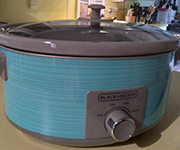
The crock pot (or slow cooker) is the best thing ever invented. That might be up for debate, but not on my blog. I haven’t found an easier way to cook, unless we’re having sandwiches for supper.
Here’s what I love about it. You prepare the veggies and meat (wash, cut, season), then pop it all into the cooker, add a tiny bit of water/broth/whatever, then turn it on low and go write your bestselling novel. Or go back to bed and binge a show, it’s up to you, no judgment here. Roughly eight hours later, supper’s done.
The specifics on which veggies go best with which meat and the prepping/seasoning will vary depending on what you’re cooking. Here’s my favorite slow cooker recipe:
Gotta Meet My Deadlines Cube Steak
Ingredients
1 package (usually containing 3-5) cube steaks
1 yellow onion, cut into roughly 1/4-inch slices
4.5-oz. jar sliced mushrooms, drained
1/2 cup flour
Salt, pepper, other spices, to taste
1 packet of onion soup mix
1 cup water
Directions
1. Cut the cube steaks into strips about 1-2 inches wide. (If you prefer, you can keep the steaks their original size. I like them cut.)
2. Add the salt, pepper, and whatever other spices you like into the flour. Mix.
3. Spread the flour/seasoning onto a plate or sheet of wax paper and roll the cube steak pieces through it until the pieces are floured up.
4. Layer into the slow cooker in the following order: onions, steak, mushrooms, onions, steak, mushrooms, onions.
5. Mix the soup mix and water, then pour over all.
6. Cook on low for 7-8 hours.
Serve over cooked egg noodles or mashed potatoes.

 Go Write Right Now